
Topics covered in this article
- What is rosacea?
- Rosacea is not ordinary acne
- Why does rosacea happen?
- Main rosacea triggers
- Symptoms of rosacea
- Types and presentations of rosacea
- Erythematotelangiectatic rosacea
- Papulopustular rosacea
- Phymatous rosacea and rhinophyma
- Ocular rosacea
- Rosacea and sensitive skin
- Who has a higher risk of rosacea?
- Diagnosis
- Differences between rosacea, acne, allergy, dermatitis, and lupus
- Treatment of rosacea
- Daily skin care
- Sunscreen and rosacea
- Makeup and cosmetics
- Food and drinks
- Is there a cure for rosacea?
- Possible complications
- When to seek medical care
- Myths and facts
- Quick FAQ
- Important disclaimer
- References and further reading
What is rosacea?
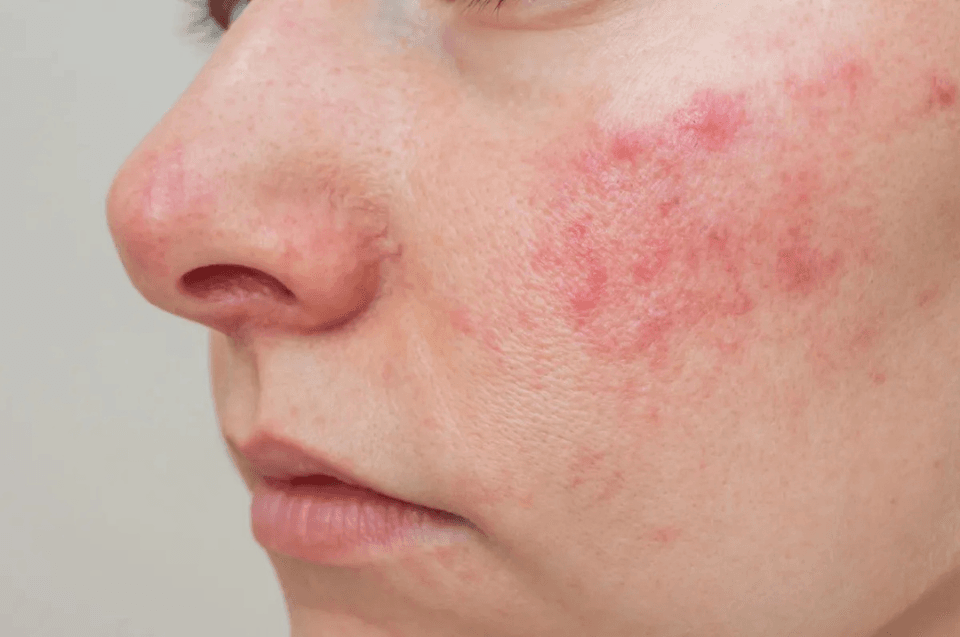
Rosacea is a chronic inflammatory skin condition that mainly affects the face.
It often causes redness, warmth, burning, sensitivity, visible blood vessels, and, in some cases, bumps that look like acne.
The most commonly affected areas include:
- Cheeks.
- Nose.
- Forehead.
- Chin.
- The area around the eyes.
Rosacea can occur in flares, with periods of worsening and improvement.
Some people initially have only temporary facial redness.
Over time, the redness may become more persistent, and small visible blood vessels may appear on the skin.
In other cases, papules and pustules develop. These are inflamed bumps that can resemble pimples.
Important: rosacea is a chronic but controllable condition. It is not caused by poor hygiene, and it does not mean that the person has ordinary acne.
Rosacea is not ordinary acne
Rosacea can be confused with acne because some people develop inflamed lesions that look like pimples.
For this reason, the term “acne rosacea” is still sometimes used.
However, rosacea and acne are different conditions.
In ordinary acne, it is common to find:
- Open comedones, also called blackheads.
- Closed comedones, also called whiteheads.
- Increased oiliness.
- Pimples on the face, chest, and back.
- A relationship with adolescence, hormones, and clogged pores.
In rosacea, it is more common to have:
- Facial redness.
- Easy flushing.
- A sensation of heat or burning.
- Sensitive skin.
- Small visible blood vessels.
- Inflamed bumps without typical comedones.
- Worsening with sun, heat, alcohol, spicy food, or stress.
This distinction matters because some acne treatments can irritate rosacea.
Very aggressive products, strong acids, scrubs, and excessive manipulation can worsen redness and stinging.
Why does rosacea happen?
The exact cause of rosacea is not fully understood.
It appears to involve a combination of genetic predisposition, changes in the skin’s blood vessels, exaggerated immune response, skin sensitivity, and environmental factors.
Possible mechanisms include:
- Increased reactivity of facial blood vessels.
- Skin inflammation.
- Changes in the skin barrier.
- Exaggerated response to external stimuli.
- Participation of skin microorganisms in some people.
- Possible association with Demodex mites in certain cases.
Demodex is a microscopic mite that can naturally live on human skin.
In some people with rosacea, it may be present in higher numbers or may trigger a stronger inflammatory response.
This does not mean that rosacea is simply an infestation or a contagious disease.
Important: rosacea is not caused by dirt, lack of cleansing, or poorly cared-for skin.
Main rosacea triggers
Triggers are factors that can provoke or worsen rosacea flares.
They vary from person to person.
Common triggers include:
- Sun exposure.
- Heat.
- Very hot showers.
- Saunas.
- Intense exercise.
- Alcoholic drinks.
- Spicy foods.
- Very hot beverages.
- Emotional stress.
- Cold wind.
- Sudden temperature changes.
- Irritating cosmetics.
- Aggressive scrubs.
- Some vasodilating medications.
- Inappropriate use of topical corticosteroids on the face.
Not every person worsens with all of these factors.
A useful strategy is to observe which situations trigger redness, burning, or new lesions in each individual.
A simple symptom diary can help identify patterns.
Symptoms of rosacea
Rosacea can cause skin symptoms and, in some cases, eye symptoms.
Skin symptoms may include:
- Facial redness.
- Easy facial flushing.
- Sensation of warmth.
- Stinging.
- Burning.
- Tingling.
- Sensitive skin.
- Dryness.
- Mild scaling.
- Small visible blood vessels.
- Papules and pustules.
- Mild swelling.
- Skin thickening in specific cases.
Eye symptoms may include:
- Eye redness.
- Burning eyes.
- Gritty sensation.
- Dry eyes.
- Tearing.
- Sensitivity to light.
- Irritated eyelids.
- Recurrent styes.
Severity varies widely.
Some people have mild and occasional symptoms.
Others experience frequent flares, persistent redness, and significant discomfort.
Types and presentations of rosacea
Rosacea can present in different ways.
The same person may have more than one presentation at the same time.
The best-known presentations include:
- Erythematotelangiectatic rosacea.
- Papulopustular rosacea.
- Phymatous rosacea.
- Ocular rosacea.
These names help describe the predominant pattern, but individual evaluation is more important than placing every patient into only one category.
Erythematotelangiectatic rosacea
This presentation is marked by facial redness, flushing, and small visible blood vessels.
The term “erythema” means redness.
The term “telangiectasias” refers to small blood vessels visible at the surface of the skin.
Common features include:
- Redness on the cheeks, nose, forehead, or chin.
- Flushing triggered by heat, sun, alcohol, or emotions.
- Burning or stinging sensation.
- Skin sensitivity to cosmetics.
- Visible small blood vessels.
At first, the redness may come and go.
Over time, it may become more persistent.
This form can be very bothersome because of both its cosmetic impact and the sensation of skin that feels “always irritated.”
Papulopustular rosacea
This form causes inflamed lesions that resemble pimples.
Papules are small raised red bumps.
Pustules are lesions with pus-like content.
Despite the resemblance to acne, typical blackheads and whiteheads are usually absent.
The lesions commonly appear in the central face, especially on the:
- Cheeks.
- Nose.
- Chin.
- Forehead.
There may also be background redness, burning, and sensitivity.
This form can be mistaken for adult acne, perioral dermatitis, or a reaction to cosmetics.
Important: squeezing the lesions can worsen inflammation, irritation, and marks.
Phymatous rosacea and rhinophyma
Phymatous rosacea is a less common form in which the skin gradually thickens.
The skin may become irregular, enlarged, or thick in texture.
When it affects the nose, it is called rhinophyma.
Rhinophyma can cause:
- Increased size of the nose.
- Irregular texture.
- Visible pores.
- Thickened skin.
- Significant cosmetic change.
This presentation is more common in men and usually appears in longer-standing cases.
Rhinophyma was unfairly associated with alcohol use for a long time.
Although alcohol can worsen rosacea flares in some people, it is not the sole cause of rhinophyma.
Important: rhinophyma is a manifestation of rosacea and can be treated with dermatological care, procedures, and, in some cases, surgery or laser treatment.
Ocular rosacea
Rosacea can affect the eyes and eyelids.
This is called ocular rosacea.
It can occur together with skin symptoms or, in some cases, before obvious skin signs appear.
Possible symptoms include:
- Red eyes.
- Burning.
- Gritty sensation in the eyes.
- Dry eyes.
- Tearing.
- Sensitivity to light.
- Itchy eyelids.
- Swollen eyelids.
- Recurrent styes.
- Blurred vision in some cases.
Ocular rosacea can be confused with conjunctivitis, eye allergy, or ordinary dry eye.
When it is not recognized, it can cause prolonged discomfort.
In more significant cases, inflammation of the cornea may occur.
Important: eye pain, intense sensitivity to light, vision changes, or persistent eye redness require medical evaluation, preferably by an ophthalmologist.
Rosacea and sensitive skin
Many people with rosacea have sensitive skin.
This means that the skin reacts easily to products, weather, heat, wind, cosmetics, or aggressive treatments.
Sensitivity symptoms may include:
- Stinging when applying products.
- Burning.
- Tightness.
- Redness after washing the face.
- Intolerance to acids and exfoliants.
- Worsening with perfumes or fragrances.
For this reason, caring for the skin barrier is a central part of treatment.
Simple, gentle, fragrance-free products are often better tolerated.
A routine with many active ingredients is not always better.
In rosacea, too many products can make the condition worse.
Who has a higher risk of rosacea?
Rosacea can affect anyone, but it is more common in adults.
It often begins between the ages of 30 and 50, although it can appear earlier or later.
Associated factors include:
- Family history of rosacea.
- Fair skin, although rosacea can occur in any skin tone.
- A tendency to flush easily.
- Sensitive skin.
- Frequent sun exposure.
- Environments with intense heat, cold, or wind.
In darker skin tones, rosacea may be underdiagnosed.
This happens because redness may be less visible.
In these cases, symptoms such as burning, heat, sensitivity, inflammatory bumps, and eye symptoms can help raise suspicion.
Diagnosis
The diagnosis of rosacea is usually clinical.
This means that a dermatologist evaluates the appearance of the skin, symptoms, lesion location, and reported triggers.
During the consultation, the following may be considered:
- Persistent facial redness.
- History of easy flushing.
- Visible blood vessels.
- Papules and pustules without typical comedones.
- Burning or stinging sensation.
- Worsening with sun, heat, alcohol, spicy foods, or stress.
- Eye symptoms.
- Use of corticosteroids or irritating cosmetics.
- Other associated skin conditions.
In most cases, laboratory testing is not needed to confirm rosacea.
Tests may be considered when there is uncertainty with other conditions, such as lupus, dermatitis, acne, infection, drug reaction, or other inflammatory diseases.
Differences between rosacea, acne, allergy, dermatitis, and lupus
Rosacea can be confused with several conditions that affect the face.
Acne
Acne often causes comedones, pimples, oiliness, and lesions on the face, chest, and back.
Rosacea causes redness, flushing, burning, visible blood vessels, and inflamed bumps without typical blackheads or whiteheads.
Skin allergy
Allergic reactions can cause itching, red plaques, swelling, or irritation after contact with a product, medication, or food.
Rosacea tends to be chronic, recurrent, and linked to vascular and inflammatory triggers.
Seborrheic dermatitis
Seborrheic dermatitis often causes redness and scaling in oily areas, such as the eyebrows, sides of the nose, scalp, and behind the ears.
It can coexist with rosacea, which may make diagnosis more difficult.
Perioral dermatitis
Perioral dermatitis causes small lesions around the mouth, nose, or eyes.
It may be associated with topical corticosteroid use, cosmetics, or irritants.
Some presentations resemble papulopustular rosacea.
Lupus
Lupus can cause facial redness in a butterfly-shaped pattern, usually over the cheeks and bridge of the nose.
It may be associated with sun sensitivity, joint pain, mouth sores, hair loss, fatigue, and changes in blood tests.
When lupus is suspected, medical evaluation is important.
Pityriasis rosea
Pityriasis rosea usually causes scaly patches on the trunk, often after one larger initial lesion.
Despite the similarity in name, it is not the same as rosacea.
Rosacea usually affects the face and is related to redness, visible blood vessels, sensitivity, and flushing.
Important: facial redness is not always rosacea. Evaluation helps prevent incorrect treatment.
Treatment of rosacea
Treatment depends on the type of rosacea, symptom severity, presence of inflammatory lesions, eye symptoms, and impact on quality of life.
The goal is not only to “remove redness,” but also to control inflammation, reduce flares, improve the skin barrier, and prevent worsening.
Identifying and managing triggers
Avoiding individual triggers is an important part of treatment.
This may include managing sun exposure, heat, alcoholic drinks, very spicy foods, hot showers, and irritating cosmetics.
Not everyone needs to avoid everything.
The ideal approach is to identify what truly worsens the condition in each person.
Topical treatments
Medications applied to the skin may be recommended to control inflammation, papules, pustules, and redness.
Possible options include:
- Topical metronidazole.
- Azelaic acid.
- Topical ivermectin.
- Brimonidine in selected cases of persistent redness.
- Oxymetazoline in selected cases of persistent redness.
Azelaic acid may help reduce inflammation, redness, and acne-like bumps in some people with rosacea.
It may also be useful when there is a tendency to develop marks after inflammation, but it can cause stinging or irritation at first, especially in very sensitive skin.
The best choice depends on the type of rosacea and how well the skin tolerates the medication.
Some products may cause initial stinging or irritation, particularly in very sensitive skin.
For this reason, they should be used with guidance.
Oral treatments
When inflammation is moderate or severe, lesions are recurrent, or ocular rosacea is present, oral medications may be recommended.
Options may include:
- Doxycycline at anti-inflammatory or antimicrobial doses, depending on the case.
- Other antibiotics in specific situations.
- Isotretinoin in selected resistant cases, with careful medical monitoring.
These medications should not be used without medical guidance.
Some have contraindications, interactions, and specific precautions, especially during pregnancy or when trying to become pregnant.
Laser and intense pulsed light
Vascular laser and intense pulsed light may help reduce visible blood vessels and persistent redness.
These treatments mainly act on superficial blood vessels.
They can be useful for telangiectasias and persistent erythema.
The number of sessions varies, and response depends on skin type, severity, and the technology used.
Treatment of ocular rosacea
Ocular rosacea may require specific care.
Possible measures include:
- Eyelid hygiene.
- Warm compresses when recommended.
- Artificial tears.
- Treatment of associated blepharitis.
- Topical or oral medications in selected cases.
- Follow-up with an ophthalmologist when needed.
Persistent eye symptoms should not be ignored.
Important: corticosteroid eye drops should not be used without medical guidance.
Daily skin care
The skin care routine should be simple and gentle.
Helpful measures include:
- Wash the face with a gentle cleanser.
- Avoid very hot water.
- Dry the skin without rubbing.
- Use moisturizer formulated for sensitive skin.
- Apply sunscreen every day.
- Avoid aggressive scrubs.
- Avoid fragrance when it irritates the skin.
- Introduce new products one at a time.
- Stop products that cause intense burning or persistent worsening.
Very complex routines can worsen rosacea.
In most cases, fewer products and more consistency produce better results.
Sunscreen and rosacea
Sun protection is one of the most important measures for controlling rosacea.
Sun exposure is a common trigger for redness and flares.
Daily sunscreen use can help reduce worsening and protect sensitive skin.
Some people tolerate mineral sunscreens with zinc oxide or titanium dioxide better.
Others do well with chemical sunscreens formulated for sensitive skin.
The ideal product is one that does not sting, does not worsen redness, and feels comfortable enough for daily use.
In addition to sunscreen, other measures can help:
- Wear a hat or cap.
- Prefer shade during peak sun hours.
- Avoid prolonged sun exposure.
- Wear sunglasses when eye symptoms are present.
Important: the best sunscreen is the one a person can use every day without irritating the skin.
Makeup and cosmetics
People with rosacea can use makeup, but products should be chosen carefully.
Products designed for sensitive skin, fragrance-free formulas, and non-comedogenic options are often better tolerated.
Some foundations or concealers with a green tint can help neutralize redness.
However, heavy makeup, fragranced products, and harsh makeup removers can irritate the skin.
Helpful tips include:
- Test new products on a small area before applying them to the whole face.
- Avoid fragrance if the skin is sensitive.
- Remove makeup with gentle products.
- Avoid rubbing the face.
- Moisturize the skin before makeup when needed.
- Do not use expired products.
If a cosmetic causes strong stinging, persistent redness, or worsening lesions, it should be stopped and evaluated.
Food and drinks
Foods and drinks can act as triggers in some people with rosacea.
The most commonly reported include:
- Alcoholic drinks, especially red wine in some patients.
- Spicy foods.
- Very hot beverages.
- Foods that individually cause facial warmth or flushing.
This does not mean that everyone with rosacea needs a very restrictive diet.
The best strategy is to observe which foods or drinks actually worsen symptoms.
Avoiding confirmed triggers may help.
Eliminating many foods unnecessarily can make the routine harder without providing real benefit.
Important: rosacea is not caused simply by “eating wrong.” Diet may influence flares in some people, but it is not the only cause of the condition.
Is there a cure for rosacea?
Rosacea is considered a chronic condition.
This means that it may persist over time, with periods of improvement and worsening.
For most cases, rosacea is not described as permanently curable.
However, it can often be very well controlled.
With appropriate treatment, daily care, and trigger management, it is possible to reduce:
- Redness.
- Flushing episodes.
- Burning.
- Sensitivity.
- Inflammatory lesions.
- Cosmetic impact.
- Eye discomfort.
Control usually requires consistency.
Even after improvement, the skin may remain sensitive and prone to future flares.
Possible complications
Rosacea can cause physical and emotional complications.
Possible consequences include:
- Persistent redness.
- Permanent visible blood vessels.
- Frequent burning or stinging flares.
- Very sensitive skin.
- Recurrent inflammatory lesions.
- Marks after inflammation.
- Skin thickening in phymatous cases.
- Rhinophyma.
- Dry eye and eye irritation.
- Corneal inflammation in more severe ocular cases.
- Impact on self-esteem and social life.
Early treatment can help reduce flares and prevent progression in many cases.
Ocular rosacea deserves special attention because eye symptoms may require specific follow-up.
When to seek medical care
Seek medical evaluation if there is persistent facial redness, burning, sensitivity, or recurrent inflamed lesions on the face.
Evaluation is especially important when there is:
- Redness that does not improve.
- Frequent flushing.
- Visible facial blood vessels.
- Pimple-like lesions without comedones.
- Intense stinging.
- Skin that reacts to almost every product.
- Worsening with sun, heat, or alcohol.
- Eye symptoms.
- Recurrent styes.
- Vision changes.
- Thickening of the nose or other areas.
- Uncertainty with acne, allergy, dermatitis, or lupus.
Eye symptoms such as pain, sensitivity to light, blurred vision, or persistent redness should be evaluated promptly.
Important: using strong corticosteroids on the face without guidance can worsen rosacea or cause rosacea-like eruptions.
Myths and facts
“Rosacea causes facial redness.”
Fact.
“Rosacea is always acne.”
Myth.
“Skin with rosacea can sting and burn.”
Fact.
“Rosacea is caused by poor hygiene.”
Myth.
“Sun and heat can worsen rosacea.”
Fact.
“Alcohol can be a trigger in some people.”
Fact.
“Everyone with rosacea must eliminate all spicy foods.”
Myth.
“Rosacea can affect the eyes.”
Fact.
“Strong corticosteroids on the face are always safe for redness.”
Myth.
“Rosacea can be controlled with treatment and appropriate care.”
Fact.
Quick FAQ
What is rosacea?
It is a chronic inflammatory skin condition that mainly affects the face and may cause redness, flushing, burning, visible blood vessels, and acne-like bumps.
Is rosacea acne?
No. It can resemble acne in some cases, but it usually does not have typical blackheads or whiteheads and is strongly related to redness, sensitivity, and triggers.
Is there a cure for rosacea?
Rosacea is usually chronic, but it can often be well controlled with treatment, sun protection, gentle skin care, and trigger management.
What worsens rosacea?
Sun, heat, alcohol, spicy foods, hot drinks, stress, hot showers, irritating cosmetics, and cold wind can worsen symptoms in some people.
Does rosacea itch?
It can itch, but burning, stinging, and sensitivity are very common symptoms.
Is rosacea contagious?
No. Rosacea is not spread through touch, kissing, shared objects, or living with someone.
Can people with rosacea wear makeup?
Yes, as long as the products are well tolerated. Fragrance-free formulas for sensitive skin are often better.
Which sunscreen is best for rosacea?
The best sunscreen is one that does not irritate the skin and can be used every day. Some people tolerate mineral sunscreens better, but this varies.
Can rosacea affect the eyes?
Yes. Ocular rosacea can cause dry eyes, burning, redness, gritty sensation, tearing, and recurrent styes.
Does alcohol cause rosacea?
Alcohol is not the sole cause of rosacea, but it can trigger flares in some people.
Do corticosteroids improve rosacea?
Corticosteroids may temporarily reduce redness, but inappropriate use on the face can worsen rosacea and cause unwanted effects.
Can laser cure rosacea?
Laser and intense pulsed light can help with visible blood vessels and persistent redness, but they do not replace daily care and do not prevent all future flares.
Important disclaimer
This content is for educational purposes only and does not replace professional medical evaluation. Facial redness can have many causes, including rosacea, acne, dermatitis, allergies, lupus, drug reactions, and infections. Seek medical care if there is severe pain, rapid worsening, sores, pus, fever, very painful lesions, eye symptoms, sensitivity to light, blurred vision, or suspected medication reaction. Do not use strong corticosteroids, antibiotics, acids, isotretinoin, eye drops, or home treatments without professional guidance.
References and further reading
- American Academy of Dermatology (AAD). Rosacea: overview, symptoms, causes, and treatment.
- National Rosacea Society. All about rosacea: triggers, signs, and management.
- DermNet NZ. Rosacea.
- British Association of Dermatologists. Rosacea patient information.
- National Health Service (NHS). Rosacea.
- Mayo Clinic. Rosacea: symptoms and causes.
- Cleveland Clinic. Rosacea: diagnosis and treatment.
- Merck Manual Professional Version. Rosacea.
- StatPearls. Rosacea.
- Journal of the American Academy of Dermatology. Guidelines and reviews on rosacea classification and management.