
Topics covered in this article
- What is nevus comedonicus?
- Why does nevus comedonicus look like blackheads?
- Is nevus comedonicus acne?
- What causes nevus comedonicus?
- Where does nevus comedonicus usually appear?
- Symptoms and appearance of the lesions
- Types of nevus comedonicus
- Nevus comedonicus syndrome
- When should associated abnormalities be investigated?
- Diagnosis
- When may a biopsy be needed?
- Differences between nevus comedonicus, acne, and other skin conditions
- Treatment of nevus comedonicus
- Daily skin care
- Can nevus comedonicus turn into cancer?
- When to seek medical care
- Myths and facts
- Quick FAQ
- Important disclaimer
- References and further reading
What is nevus comedonicus?
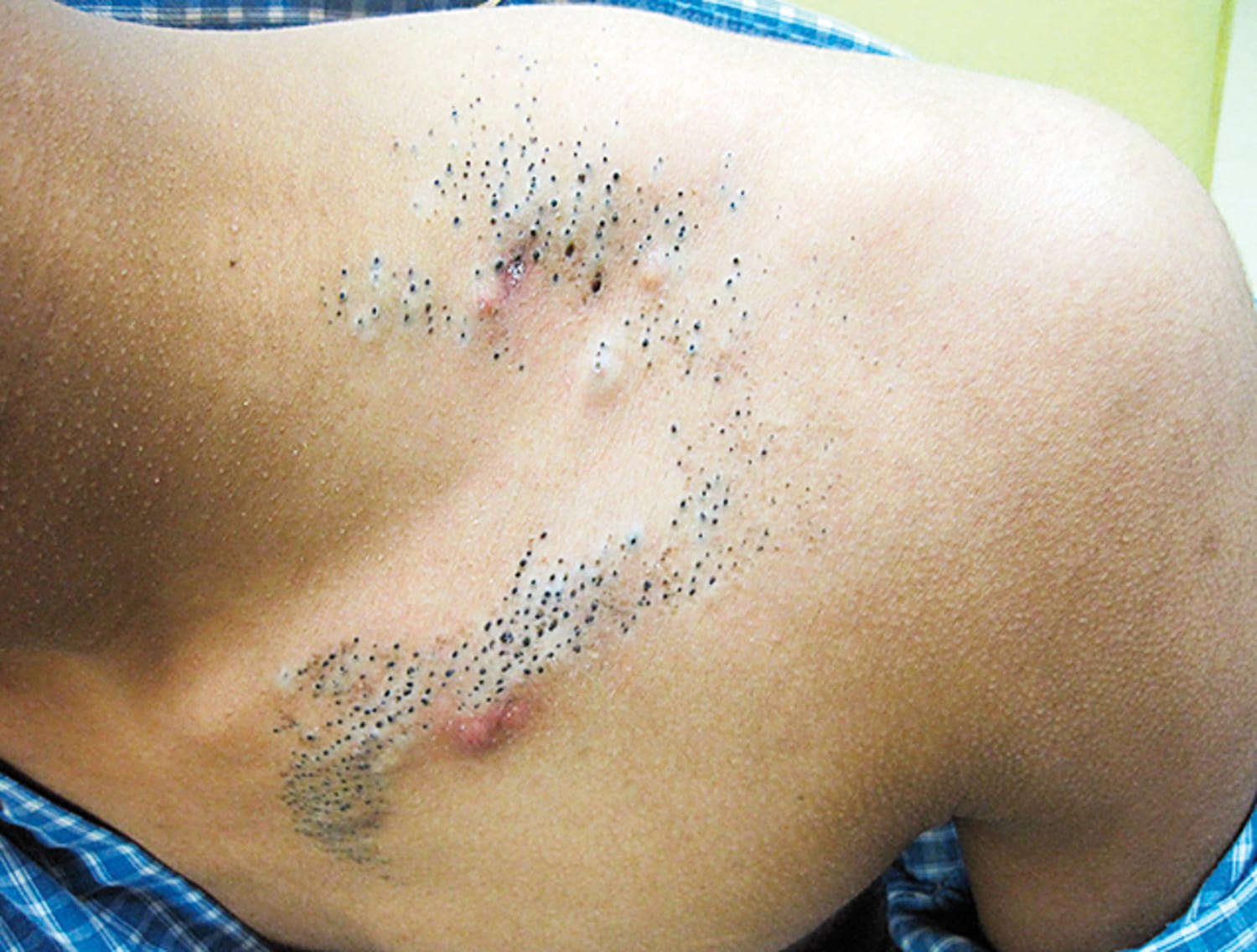
Nevus comedonicus, also spelled naevus comedonicus, is a rare skin condition characterized by grouped lesions that resemble blackheads.
These lesions often appear as small dark spots, dilated pores, or openings filled with keratin, a protein naturally found in the skin.
Although the lesions may look similar to ordinary blackheads, nevus comedonicus is not simply acne.
It is considered a type of epidermal nevus, meaning a localized developmental abnormality involving the epidermis, the outermost layer of the skin.
In most cases, it appears at birth, during childhood, or during adolescence.
Some people have only a small localized area. Others may have larger plaques arranged in a line, band, or segmental pattern on the body.
Important: nevus comedonicus is usually benign, but it can cause inflammation, infection, cysts, cosmetic concerns, scarring, or discomfort when extensive or repeatedly inflamed.
Why does nevus comedonicus look like blackheads?
The blackhead-like appearance occurs because some skin structures become dilated and filled with keratin.
This keratin can form dark or yellowish plugs inside small openings in the skin.
Visually, these plugs may resemble open comedones, which are the blackheads commonly seen in acne.
However, in nevus comedonicus, the lesions tend to be clustered in a specific area and may follow a linear or segmental pattern.
They are also often present from an early age and do not behave like ordinary acne.
In acne, blackheads usually occur in oily areas such as the face, chest, and back. They may fluctuate with age, hormones, oil production, and inflammation.
In nevus comedonicus, the lesions usually represent a localized skin developmental change with a more fixed pattern.
Is nevus comedonicus acne?
Not exactly.
Nevus comedonicus may look like acne because it forms blackhead-like lesions, but it has a different origin.
Acne is a common inflammatory disease of the pilosebaceous unit, involving oil production, pore blockage, bacteria, inflammation, and hormonal influence.
Nevus comedonicus is a localized developmental abnormality of the skin.
Important differences include:
- Nevus comedonicus often forms fixed clusters of lesions.
- It may be present from birth or childhood.
- It may follow lines or bands on the skin.
- It is not necessarily related to oily skin.
- It may not respond to standard acne treatment in the same way.
- It can become inflamed and form cysts, but that does not automatically mean it is ordinary acne.
Important: treating nevus comedonicus as if it were only acne may delay the correct diagnosis and lead to unnecessary or harmful skin manipulation.
What causes nevus comedonicus?
Nevus comedonicus occurs because of a localized change in skin development.
In many cases, it is thought to be related to cutaneous mosaicism.
Mosaicism means that some skin cells have a genetic change acquired during embryonic development, while other cells in the body do not have that same change.
This helps explain why the lesions may be limited to one specific area of the body.
Nevus comedonicus is usually not caused by:
- Poor hygiene.
- Dirt on the skin.
- Makeup use.
- A specific diet.
- Contagion from another person.
In most cases, the patient and family are not responsible for the condition.
It simply reflects a localized difference in how part of the skin developed.
Where does nevus comedonicus usually appear?
Nevus comedonicus can appear in different parts of the body.
Possible locations include:
- Face.
- Neck.
- Scalp.
- Trunk.
- Arms.
- Legs.
- Buttocks.
The lesions may involve a small area or extend across a larger band of skin.
In some cases, they follow developmental skin patterns known as the lines of Blaschko.
These lines are not visible in people without skin findings, but they can guide the pattern of certain congenital or developmental dermatological conditions.
When the nevus is extensive, frequently inflamed, or associated with other symptoms, dermatological evaluation becomes especially important.
Symptoms and appearance of the lesions
Nevus comedonicus can vary from person to person.
The lesions may appear as:
- Dark dots that look like blackheads.
- Grouped dilated pores.
- Small depressions in the skin.
- Plaques with multiple openings filled with keratin.
- Lesions arranged in a line, band, or cluster.
- Rough or irregular skin texture.
In many cases, the lesions are not painful.
However, some people may develop:
- Recurrent inflammation.
- Redness.
- Local pain.
- Drainage.
- Unpleasant odor when infection is present.
- Cysts.
- Abscesses.
- Scarring.
- Cosmetic distress.
When inflammation occurs repeatedly, the impact on quality of life can be significant.
This is especially true when the lesions appear on the face, neck, visible areas, or areas exposed to friction.
Types of nevus comedonicus
Nevus comedonicus may be described in different ways depending on appearance, extent, and behavior.
Non-inflammatory form
In the non-inflammatory form, blackhead-like lesions, dilated pores, and keratin plugs predominate.
There may be little or no symptom beyond appearance.
This form may remain stable for many years.
Inflammatory form
In the inflammatory form, cysts, pustules, abscesses, and scars may occur in addition to comedone-like lesions.
This form can cause pain, drainage, and episodes of secondary infection.
In some cases, it may resemble inflammatory acne, hidradenitis suppurativa, or other conditions that cause cysts and abscesses.
Localized form
The localized form involves a small or limited area.
It may have minimal clinical impact depending on its location.
Extensive or segmental form
The extensive form can involve larger areas of the body and may follow a linear or segmental pattern.
When very extensive or associated with other signs, additional evaluation may be needed.
Nevus comedonicus syndrome
In most people, nevus comedonicus is limited to the skin.
However, in rare cases, it may be part of nevus comedonicus syndrome.
In this situation, the skin lesions may be associated with changes in other parts of the body.
Reported associations may include:
- Bone abnormalities.
- Eye abnormalities.
- Central nervous system abnormalities.
- Body asymmetry.
- Malformations or developmental differences in the limbs.
- Developmental delay in some cases.
- Seizures in specific situations.
These associations are uncommon, but they should be considered when the condition is extensive, appears very early, or occurs with symptoms outside the skin.
Important: having nevus comedonicus does not automatically mean a person has a syndrome. Most cases are limited to the skin.
When should associated abnormalities be investigated?
Investigation of associated abnormalities may be considered when there are signs suggesting involvement beyond the skin.
These signs may include:
- Very extensive lesions.
- Large areas of involvement present from birth.
- Differences in growth of the arms or legs.
- Significant body asymmetry.
- Vision changes or eye abnormalities.
- Seizures.
- Developmental delay.
- Bone pain or deformities.
- Other visible malformations.
In these cases, the dermatologist may recommend evaluation by other specialists, such as a pediatrician, ophthalmologist, neurologist, orthopedist, or geneticist, depending on the findings.
The goal is not to create alarm, but to make sure important signs are not missed.
Diagnosis
The diagnosis of nevus comedonicus is often clinical.
This means that a dermatologist may suspect the condition by examining the pattern of the lesions, age of onset, distribution, and skin appearance.
During the consultation, the clinician may assess:
- When the lesions first appeared.
- Whether they have increased over time.
- Whether they become inflamed or infected.
- Whether there is pain, drainage, or unpleasant odor.
- Whether scarring is present.
- Whether there is a history of other health changes.
- Whether there is cosmetic or emotional impact.
Dermoscopy may help in some cases.
This examination uses a magnifying device with light to evaluate skin details that are not easily visible to the naked eye.
When the presentation is typical, additional tests may not be necessary.
When may a biopsy be needed?
A skin biopsy may be recommended when the diagnosis is uncertain or when the lesions have an unusual appearance.
A biopsy involves removing a small piece of skin for microscopic analysis.
It may help distinguish nevus comedonicus from other conditions, such as:
- Comedonal acne.
- Epidermal nevus.
- Epidermoid cysts.
- Dilated pores.
- Hidradenitis suppurativa in some presentations.
- Other rare follicular disorders.
Under the microscope, nevus comedonicus typically shows dilated follicular structures filled with keratin.
Important: not every case requires a biopsy. The decision depends on medical evaluation.
Differences between nevus comedonicus, acne, and other skin conditions
Nevus comedonicus may be confused with several dermatological conditions.
Comedonal acne
Comedonal acne causes open and closed comedones, usually in oily areas such as the face, chest, and back.
It is often related to adolescence, oil production, hormones, and individual predisposition.
Nevus comedonicus tends to be more localized, fixed, and segmental.
Inflammatory acne
Inflammatory acne causes pimples, papules, pustules, nodules, and, in severe cases, scarring.
Nevus comedonicus can become inflamed, but the distribution and history are usually different.
Hidradenitis suppurativa
Hidradenitis suppurativa causes painful nodules, abscesses, and tunnels under the skin, mainly in the armpits, groin, buttocks, and under the breasts.
Some inflammatory forms of nevus comedonicus may resemble hidradenitis, but they are different conditions.
Epidermoid cysts
Epidermoid cysts are lumps under the skin filled with keratinous material.
They can become inflamed and painful.
In nevus comedonicus, cysts may develop within an area of blackhead-like lesions.
Other epidermal nevi
Epidermal nevus is a group of skin developmental abnormalities that may form plaques, thickened areas, or wart-like lesions.
Nevus comedonicus is a variant with a comedone-like appearance.
Important: a blackhead-like appearance does not automatically mean acne.
Treatment of nevus comedonicus
Treatment depends on extent, location, symptoms, inflammation, scarring risk, and cosmetic impact.
Not every case of nevus comedonicus needs treatment.
When the lesions are small, stable, and asymptomatic, observation and avoidance of manipulation may be enough.
Topical treatments
Skin-applied treatments may help reduce keratin plugs and improve texture in some cases.
Options that may be considered include:
- Topical retinoids.
- Salicylic acid.
- Urea.
- Lactic acid.
- Other keratolytic agents.
These treatments may help superficial lesions, but response varies.
Irritation, redness, peeling, and sensitivity can occur, especially when these products are used without guidance.
Control of inflammation
When inflammation, secondary infection, cysts, or abscesses occur, specific treatment may be needed.
Depending on the situation, management may include:
- Warm compresses.
- Antiseptics recommended by a healthcare professional.
- Topical or oral antibiotics when bacterial infection is present.
- Drainage of abscesses in selected situations.
- Treatment of inflamed cysts.
The choice depends on severity, location, and signs of infection.
Dermatological procedures
Procedures may be considered when lesions are persistent, localized, or cosmetically significant.
Possible options include:
- Careful extraction of keratin plugs in selected cases.
- CO2 laser.
- Er:YAG laser.
- Dermabrasion in specific situations.
- Electrosurgery in some cases.
- Surgical excision when the area is small and well defined.
Procedures may improve appearance, but they can also leave scars, pigment changes, or partial recurrence.
For this reason, the decision should balance cosmetic benefit, scarring risk, and realistic expectations.
Surgery
Surgical removal may be an option for small, localized, and highly bothersome lesions.
For extensive lesions, surgery may not be practical or may leave a scar larger than the original affected area.
In some cases, treatment is performed in stages.
Important: there is no single treatment that works for every case. Management must be individualized.
Daily skin care
Some daily measures may help reduce irritation, inflammation, and secondary infection.
- Do not squeeze the lesions.
- Avoid picking or trying to remove plugs with sharp objects.
- Do not use harsh home remedies.
- Avoid acids or strong exfoliants without guidance.
- Use gentle skin cleansing.
- Avoid excessive friction over the area.
- Use sunscreen when the area is exposed.
- Seek care if there is pain, pus, intense redness, or unpleasant odor.
Squeezing can cause inflammation, wounds, pigmentation changes, infection, and scarring.
Even if blackhead-like material comes out, the lesion may accumulate keratin again.
Proper care is safer than repeated manipulation.
Can nevus comedonicus turn into cancer?
Nevus comedonicus is considered benign in most cases.
Malignant transformation is extremely uncommon.
Even so, any skin lesion that changes significantly should be evaluated.
Seek medical advice if there is:
- Rapid growth.
- Bleeding without trauma.
- A wound that does not heal.
- Persistent pain.
- Significant color change.
- Progressive hardening.
- Recurrent drainage.
- Frequent inflammation.
These signs do not necessarily mean cancer, but they do indicate the need for medical evaluation.
When to seek medical care
See a dermatologist if you or your child has blackhead-like lesions that:
- Have been present since birth or childhood.
- Are grouped in the same area.
- Form a line, band, or plaque.
- Do not improve like ordinary acne.
- Become inflamed frequently.
- Form cysts or abscesses.
- Cause pain, drainage, or unpleasant odor.
- Leave scars.
- Are gradually enlarging.
- Cause significant cosmetic distress.
Evaluation is also important when lesions are extensive or occur with eye, bone, neurological, developmental, or limb growth changes.
Important: early diagnosis can guide proper care and help avoid manipulation that may worsen the condition.
Myths and facts
“Nevus comedonicus can look like blackheads.”
Fact.
“Nevus comedonicus is always ordinary acne.”
Myth.
“The condition may be present from childhood.”
Fact.
“Nevus comedonicus is caused by poor hygiene.”
Myth.
“The lesions may form lines or bands on the skin.”
Fact.
“Squeezing always solves the problem.”
Myth.
“Some cases can become inflamed and form cysts.”
Fact.
“Every case of nevus comedonicus is part of a syndrome.”
Myth.
“Most cases are benign.”
Fact.
“Treatment depends on extent, symptoms, and location.”
Fact.
Quick FAQ
What is nevus comedonicus?
It is a rare skin condition that forms clusters of blackhead-like lesions, usually due to keratin buildup within dilated follicular structures.
Is nevus comedonicus acne?
Not exactly. It can resemble acne, but it is a localized developmental abnormality of the skin and usually has a more fixed pattern.
Is nevus comedonicus contagious?
No. It is not spread through touch, kissing, shared objects, or living with someone.
Is it caused by poor hygiene?
No. The condition is not caused by dirt or lack of cleansing.
Can it appear in children?
Yes. It often appears at birth, during childhood, or during adolescence.
Does it need treatment?
Not always. Small, asymptomatic lesions may only need observation. Treatment may be considered when there is inflammation, infection, cysts, pain, scarring, or cosmetic concern.
Can I squeeze it?
It is not recommended. Squeezing can cause wounds, infection, dark marks, and scars.
Is there a cream for nevus comedonicus?
Some topical treatments, such as retinoids or keratolytic agents, may help in selected cases, but they should be used with dermatological guidance.
Can laser treatment help?
Laser treatment may be an option in selected cases. Results vary, and there may be a risk of pigmentation changes, scarring, or partial recurrence.
Can nevus comedonicus become cancer?
It is benign in most cases, and malignant transformation is extremely uncommon. Major changes should still be evaluated.
What is nevus comedonicus syndrome?
It is a rare situation in which nevus comedonicus is associated with abnormalities outside the skin, such as bone, eye, or neurological findings.
Which doctor evaluates it?
A dermatologist is the most appropriate specialist to assess, diagnose, and guide treatment.
Important disclaimer
This content is for educational purposes only and does not replace professional medical evaluation. Blackhead-like skin lesions, especially when they appear in fixed clusters, lines, bands, from childhood, or with recurrent inflammation, should be assessed by a healthcare professional. Seek medical care if there is pain, pus, intense redness, fever, unpleasant odor, bleeding, a wound that does not heal, rapid growth, or significant change in appearance. Do not squeeze, cut, apply acids, use home remedies, or start medications without professional guidance.
References and further reading
- DermNet NZ. Nevus comedonicus.
- StatPearls. Nevus Comedonicus.
- Orphanet. Nevus comedonicus and related epidermal nevus syndromes.
- American Academy of Dermatology (AAD). Acne and comedonal skin lesions: clinical information for patients.
- British Association of Dermatologists. Patient information resources on epidermal naevi and congenital skin lesions.
- Merck Manual Professional Version. Benign skin tumors and epidermal nevi.
- UpToDate. Epidermal nevi and related syndromes: clinical features and management.
- Journal of the American Academy of Dermatology. Reviews and case reports on nevus comedonicus and inflammatory variants.
- Pediatric Dermatology. Congenital and childhood presentations of nevus comedonicus.
- Indian Dermatology Online Journal. Nevus comedonicus: clinical features and treatment approaches.