
Topics covered in this article
- What is nail cancer?
- What is nail melanoma?
- Brown or black line on the nail: when should you worry?
- Not every dark line on the nail is cancer
- Warning signs of nail melanoma
- What is Hutchinson sign?
- The ABCDEF rule for nail melanoma
- Other ways nail cancer can appear
- Squamous cell carcinoma of the nail
- Other tumors that can affect the nail
- Differences between nail cancer, fungal infection, trauma, hematoma, and wart
- Who has a higher risk?
- Diagnosis
- Nail dermoscopy
- When is biopsy necessary?
- Treatment of nail cancer
- Prognosis and the importance of early diagnosis
- Care and prevention
- When to seek medical care
- Myths and facts
- Quick FAQ
- Important disclaimer
- References and further reading
What is nail cancer?
Nail cancer is a popular term used to describe tumors that can arise in the nail unit.
The nail unit includes the nail plate, the matrix that produces the nail, the nail bed, the cuticle, and the surrounding skin.
The best-known and most concerning type is nail melanoma, also called subungual melanoma when it appears under the nail.
It can appear as a brown or black line on the nail, but this is not the only possible sign.
Other tumors can also affect the nail area, including squamous cell carcinoma, basal cell carcinoma in rare cases, Bowen disease, adnexal tumors, and metastases, although these are less common.
The main problem is that malignant nail changes can be mistaken for fungal infection, trauma, a wart, a hematoma, an ingrown nail, or ordinary inflammation.
This can delay diagnosis.
Important: a dark line on the nail is not always cancer, but a new, irregular, growing line or a line that appears in only one nail of an adult should be evaluated.
What is nail melanoma?
Nail melanoma is a type of melanoma that develops in the nail area.
Melanoma is a cancer that starts in melanocytes, the cells that produce melanin, the pigment that gives color to the skin, hair, eyes, and sometimes the nail.
When it occurs in the nail, it can arise in the nail matrix, nail bed, or nearby structures.
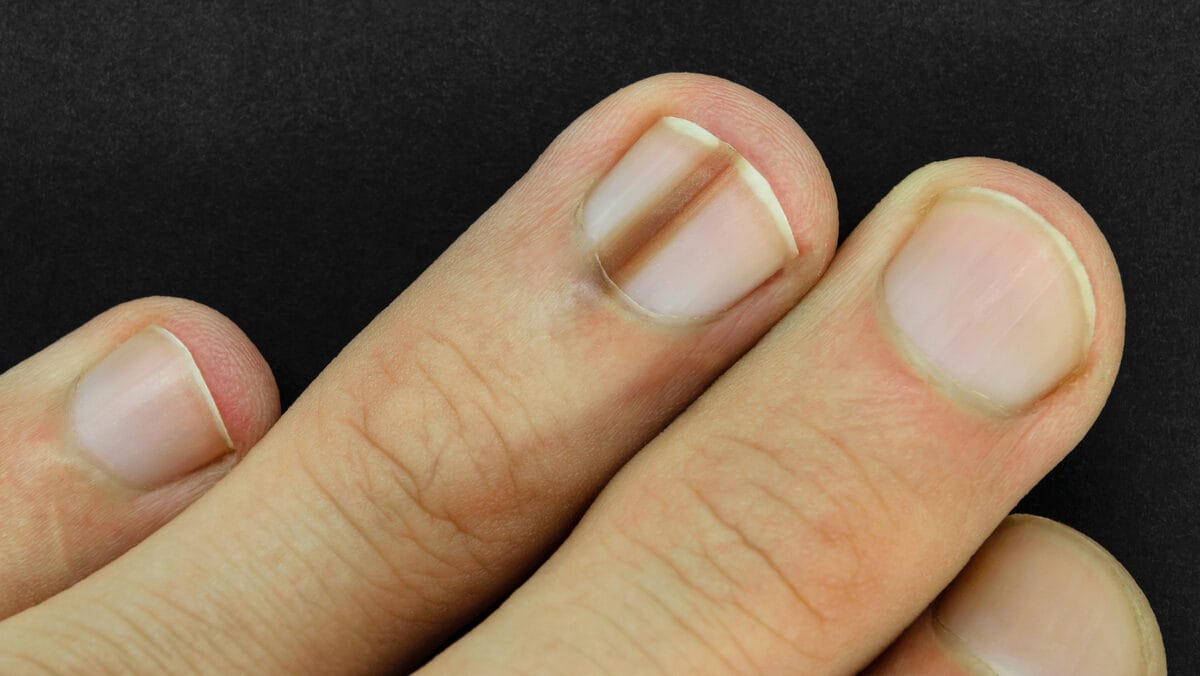
The most commonly remembered sign is a dark longitudinal band, meaning a line that follows the direction of nail growth, from the base toward the tip.
This band may be brown, black, gray, or contain more than one color.
However, nail melanoma can also appear as:
- An irregular dark spot.
- Progressive darkening of part of the nail.
- Nail change with splitting or deformity.
- Bleeding.
- A wound that does not heal.
- A lump under or around the nail.
- Nail lifting.
- Persistent pain.
- Partial nail loss or destruction.
In some cases, melanoma may have little or no pigment. This is called amelanotic melanoma.
In these cases, the lesion may look like a wound, wart, inflammation, or fleshy growth, making diagnosis even more difficult.
Brown or black line on the nail: when should you worry?
A brown or black line on the nail is called longitudinal melanonychia when it appears as a pigmented band in the direction of nail growth.
It can have benign or malignant causes.
Medical evaluation is especially important when the band has features such as:
- Recent appearance in an adult.
- Presence in only one nail.
- Progressive widening.
- Very dark color or variation in color.
- Irregular borders.
- Asymmetric shape.
- A band that is wider at the base of the nail.
- Pigment reaching the cuticle or surrounding skin.
- Association with splitting, bleeding, or nail deformity.
- History of rapid change.
One important detail is to observe whether the dark area moves with nail growth or stays in the same place.
Hematomas caused by trauma, for example, usually move toward the tip as the nail grows.
Pigmentation that originates in the nail matrix may continue to appear from the base of the nail.
Important: do not try to diagnose the cause based only on a photo or appearance. Dermoscopy and, in some cases, biopsy are essential.
Not every dark line on the nail is cancer
Despite the importance of this warning, it is essential to remember that not every brown line on the nail is melanoma.
There are several benign causes of longitudinal melanonychia.
These include:
- Racial or ethnic melanonychia, more common in people with darker skin.
- Benign activation of melanocytes in the nail matrix.
- Repeated trauma.
- Pregnancy.
- Certain medications.
- Inflammatory skin diseases.
- Infections.
- Rare genetic syndromes.
- Melanocytic nevus of the nail matrix.
In people with darker skin, pigmented lines in several nails may be a benign variation.
Even so, one band that looks different from the others, grows, changes, darkens, or appears in only one nail deserves evaluation.
In children, many pigmented nail bands are benign, but they should still be assessed when they look unusual or evolve rapidly.
The goal is not to create panic, but to recognize which signs need attention.
Warning signs of nail melanoma
Some signs increase concern for nail melanoma.
See a dermatologist if there is:
- A brown or black line that is becoming wider.
- A dark band with blurred or irregular borders.
- Variation in color within the same band.
- A band that begins at the base and expands over time.
- Pigment on the cuticle or surrounding skin.
- A nail that is cracking, thinning, deforming, or lifting.
- Bleeding without clear trauma.
- A wound that does not heal.
- A lump under the nail.
- Persistent pain in one nail.
- A change affecting only one nail, especially in adults.
- Personal or family history of melanoma.
Nail melanoma can affect fingernails or toenails.
The thumb and big toe are often mentioned among common sites, but any nail can be affected.
Important: the earlier melanoma is diagnosed, the greater the chance of effective treatment.
What is Hutchinson sign?
Hutchinson sign is the presence of dark pigmentation extending from the nail onto the surrounding skin.
This may appear on the cuticle, the side fold of the nail, or the skin near the base.
This sign is concerning because it may indicate that the pigmentation is not limited to the nail plate.
It can be associated with nail melanoma.
There is also something called pseudo-Hutchinson sign, when pigmentation appears to reach the surrounding skin but is actually seen through the transparent cuticle or nail folds.
For this reason, dermoscopic evaluation is important.
Important: pigment on the skin around the nail should be evaluated by a dermatologist, especially if it is new, irregular, or increasing.
The ABCDEF rule for nail melanoma
A practical way to remember warning signs is the ABCDEF rule for nail melanoma.
A – Age
Risk becomes more concerning when the band appears in adults, especially after the age of 40 or 50.
This does not mean younger people cannot develop melanoma, but age helps guide risk assessment.
B – Brown to black band
This refers to a brown to black band, often with greater width, irregular pigmentation, or poorly defined borders.
A band that increases in size deserves attention.
C – Change
Change is one of the most important warning signs.
This includes widening, darkening, change in shape, bleeding, pain, deformity, or any nail change over time.
D – Digit
Some digits are more commonly affected, such as the thumb, big toe, and index finger.
However, any nail can be affected.
E – Extension
This refers to extension of pigment onto the cuticle or surrounding skin, known as Hutchinson sign.
F – Family or personal history
A personal or family history of melanoma increases the need for attention.
Important: this rule helps people remember suspicious signs, but it does not replace medical evaluation.
Other ways nail cancer can appear
Although a brown or black line is the most famous sign, cancer in the nail area can appear in other ways.
Possible signs include:
- A persistent wound around the nail.
- A wart-like lesion that does not improve or returns after treatment.
- A lump or nodule under the nail.
- A nail that lifts without a clear cause.
- A nail that breaks or becomes progressively deformed.
- Recurrent bleeding.
- Persistent localized pain.
- Chronic inflammation in only one nail.
- Irregular thickening of the surrounding skin.
- Persistent drainage.
- Partial loss of the nail.
- A reddish, pink, or non-pigmented spot.
Some tumors can look like a fungal infection by thickening or deforming the nail.
Others can resemble warts, especially when they appear near the cuticle or nail folds.
For this reason, persistent changes in a single nail should be taken seriously.
Squamous cell carcinoma of the nail
Squamous cell carcinoma is another type of cancer that can affect the nail unit.
It can develop in the skin around the nail, the nail bed, or nearby areas.
It may often be mistaken for a wart, fungal infection, trauma, ingrown nail, or chronic inflammation.
Possible signs include:
- A wart-like lesion that does not improve.
- A persistent wound.
- Bleeding.
- Pain.
- Nail lifting.
- A localized change in only one nail.
- Progressive growth.
- Recurrent drainage or crusting.
Some cases may be associated with HPV, chronic trauma, immunosuppression, or previous radiation exposure, although there is not always a clear factor.
When a “wart” near the nail does not respond to treatment, returns repeatedly, or damages the nail, investigation is important.
Important: not every wart near the nail is cancer, but any persistent, painful, bleeding, or destructive lesion deserves evaluation.
Other tumors that can affect the nail
Besides melanoma and squamous cell carcinoma, other tumors can affect the nail or the surrounding area.
Some are benign, while others are malignant.
Examples include:
- Basal cell carcinoma, rare in the nail unit.
- Bowen disease, an early form of squamous cell carcinoma.
- Adnexal tumors.
- Pyogenic granuloma, usually benign, but it can bleed and cause confusion.
- Glomus tumor, usually benign and associated with intense pain in some cases.
- Metastases to the nail region, which are very rare.
Most nail changes are not cancer.
Even so, persistent, progressive, or unusual lesions should be evaluated.
The nail can hide important changes, and diagnosis may require careful examination of the matrix and nail bed.
Differences between nail cancer, fungal infection, trauma, hematoma, and wart
Several benign conditions can look like nail cancer, and the opposite can also happen.
Fungal nail infection
Fungal nail infection, or onychomycosis, often causes a yellowish, thickened, brittle, lifted nail, sometimes with debris accumulating underneath.
It usually does not cause an irregular dark brown band that widens from the base, although it can cause color changes.
When only one nail is affected and does not improve with appropriate treatment, the diagnosis should be reconsidered.
Nail trauma
Injuries, tight shoes, running, sports, and traumatic manicures can cause nail changes.
Trauma can cause spots, lifting, deformity, and hematoma.
However, changes that persist, grow, or appear without clear trauma should be evaluated.
Subungual hematoma
A subungual hematoma is a collection of blood under the nail.
It often appears after trauma and may look dark red, purple, brown, or black.
In general, it moves toward the tip as the nail grows.
If the spot does not move with nail growth, increases, or appeared without known trauma, it should be investigated.
Periungual wart
Warts around the nail are common and usually benign.
They may be caused by HPV and appear as rough lesions.
The problem is that some tumors can look like warts.
For this reason, a wart that bleeds, hurts, damages the nail, grows quickly, or does not respond to treatment should be evaluated carefully.
Benign melanonychia
Benign pigmented lines can occur because of melanocyte activation, nail matrix nevi, medications, trauma, or racial variation.
The challenge is distinguishing these causes from melanoma.
Dermatological evaluation is the safest path.
Who has a higher risk?
Nail cancer can occur in anyone.
Some factors increase concern for melanoma or other nail tumors.
These include:
- Adulthood, especially when pigmentation is new.
- Personal history of melanoma.
- Family history of melanoma.
- A dark band in only one nail.
- Progressive nail change.
- Immunosuppression.
- Chronic or recurrent lesions around the nail.
- Chronic trauma in some contexts.
- Persistent warts near the nail.
Nail melanoma can occur in people of any skin tone.
In people with darker skin, melanoma in acral areas, such as the palms, soles, and nails, deserves special attention.
This does not mean that every dark line in darker skin is cancer.
It simply means that suspicious changes should not be ignored.
Diagnosis
Diagnosis begins with clinical evaluation.
The dermatologist examines the nail, the surrounding skin, the pigmentation pattern, the evolution of the lesion, and associated symptoms.
During the consultation, the following may be assessed:
- When the change began.
- Whether there was trauma.
- Whether the spot is growing.
- Whether the band is becoming wider.
- Whether there is pain, bleeding, or drainage.
- Whether the nail is becoming deformed or lifted.
- Whether there is pigment on the surrounding skin.
- Whether other nails have similar lines.
- History of melanoma or skin cancer.
- Current medications.
- Associated skin or inflammatory diseases.
Comparing with old photos may help.
Serial photographs may also be useful in selected cases when the dermatologist considers monitoring safe.
When there is significant suspicion of cancer, photographic monitoring should not replace biopsy.
Nail dermoscopy
Dermoscopy is an examination performed with a device that magnifies and illuminates the skin and nail.
It helps identify patterns that are not visible to the naked eye.
In the nail, dermoscopy can assess:
- The color of the pigmented band.
- The regularity of the lines.
- The width of the band.
- Variation in color.
- The borders of the pigmentation.
- Presence of pigment on the surrounding skin.
- Signs of hematoma.
- Changes in the nail bed.
More regular findings may suggest benign causes.
Irregular findings may increase suspicion for melanoma.
Important: dermoscopy is very helpful, but it does not replace biopsy when suspicion is significant.
When is biopsy necessary?
Biopsy is the test that allows tissue to be analyzed under the microscope.
It may be necessary when melanoma, carcinoma, or another tumor is suspected.
In the nail, biopsy may involve the nail matrix, nail bed, or surrounding skin, depending on where the change appears to originate.
A biopsy of the nail matrix must be planned carefully because this region produces the nail.
If done improperly, it can cause permanent nail deformity.
For this reason, it should be performed by a professional experienced in this type of procedure.
Biopsy may be indicated when there is:
- A suspicious pigmented band.
- Progressive widening of a dark line.
- Hutchinson sign.
- Destructive nail change.
- A wound that does not heal.
- Persistent bleeding.
- A lump under the nail.
- A wart-like lesion that does not improve.
- Persistent diagnostic uncertainty.
Important: when nail melanoma is suspected, investigation should not be delayed indefinitely.
Treatment of nail cancer
Treatment depends on the type of tumor, size, depth, location, presence of invasion, and disease stage.
Nail melanoma
The main treatment for nail melanoma is usually surgery.
The extent of surgery depends on the depth and location of the tumor.
In some cases, conservative surgery of the nail unit may be possible.
In others, removal of a larger portion of affected tissue may be necessary.
More advanced cases may require lymph node evaluation, imaging tests, immunotherapy, targeted therapy, or specialized oncology follow-up.
Treatment has advanced greatly in recent decades, especially for advanced melanoma, but early diagnosis remains essential.
Squamous cell carcinoma of the nail
Squamous cell carcinoma is also usually treated with surgery.
Depending on the case, options may include surgical excision, Mohs micrographic surgery, or other approaches.
When there is deep invasion, recurrence, or bone involvement, treatment may be more complex.
Other tumors
Other nail tumors are treated according to the specific diagnosis.
Some only require local removal.
Others need broader investigation.
The treatment plan should be individualized.
Important: there is no home treatment for nail cancer. Attempts to cauterize, cut, file, or use aggressive products can delay diagnosis and worsen the lesion.
Prognosis and the importance of early diagnosis
Prognosis depends mainly on the type of tumor and the stage at diagnosis.
In melanoma, tumor depth is a very important factor.
The earlier melanoma is identified, the greater the chance of effective treatment and the lower the chance of spread.
The problem is that nail melanoma can be diagnosed late because it looks like a common nail change.
Many people think it is a fungal infection, injury, hematoma, or harmless mark.
Also, because it grows in a small area and may not be painful at first, it can go unnoticed.
For this reason, persistent changes in a single nail should be evaluated.
Important: a dark line that changes over time should not be “watched forever” without proper assessment.
Care and prevention
Not every nail cancer can be prevented, but some habits help detect changes early.
- Observe your nails regularly.
- Seek evaluation if a new dark line appears in one nail.
- Do not ignore wounds around the nail that do not heal.
- Avoid repetitive trauma when possible.
- Wear appropriate shoes to reduce trauma to the toes.
- Protect hands and feet from intense sun exposure when applicable.
- Do not use aggressive products to try to remove spots.
- Avoid manipulating persistent lesions with clippers, files, or sharp objects.
- See a dermatologist if a “fungal infection” in one nail does not improve with appropriate treatment.
- Photograph suspicious changes to compare evolution, but do not use this as a substitute for consultation.
Manicurists, podiatrists, and professionals who often examine nails can also help by recommending medical evaluation when they notice suspicious changes.
However, diagnosis should be made by a qualified healthcare professional.
When to seek medical care
See a dermatologist if you notice:
- A new brown, black, or gray line on the nail.
- A dark band that is becoming wider.
- An irregular dark spot in one nail.
- Pigment on the cuticle or surrounding skin.
- Progressive nail deformity.
- Nail lifting without a clear cause.
- A wound around the nail that does not heal.
- Recurrent bleeding.
- Persistent pain in one nail.
- A lump under the nail.
- A wart-like lesion that does not improve.
- A change in a single nail that does not respond to the expected treatment.
Seek care more urgently if the change is growing quickly, bleeding, destroying the nail, or associated with significant pain.
Important: waiting months or years to investigate a suspicious change can reduce the chances of early diagnosis.
Myths and facts
“A brown line on the nail can be melanoma.”
Fact.
“Every dark line on the nail is cancer.”
Myth.
“Nail melanoma can occur in people of any skin tone.”
Fact.
“If it does not hurt, it cannot be serious.”
Myth.
“Pigment on the skin around the nail can be a warning sign.”
Fact.
“Nail cancer always looks like a black line.”
Myth.
“Some tumors can look like a wart, fungal infection, or chronic wound.”
Fact.
“A hematoma caused by trauma usually moves with the nail toward the tip.”
Fact.
“Biopsy may be necessary to confirm the diagnosis.”
Fact.
“Nail cancer can be treated with home remedies.”
Myth.
Quick FAQ
What is nail cancer?
It is a term used for tumors that affect the nail unit, including nail melanoma and squamous cell carcinoma of the nail.
Is a brown line on the nail always cancer?
No. Many dark lines are benign, but a new, irregular, growing line or a line in only one nail of an adult should be evaluated.
What does nail melanoma look like?
It may appear as a brown or black longitudinal line, an irregular dark spot, pigment on the surrounding skin, nail deformity, bleeding, a wound, or a lump.
What is longitudinal melanonychia?
It is a pigmented band that follows the direction of nail growth, from the base toward the tip.
What is Hutchinson sign?
It is dark pigmentation extending onto the cuticle or surrounding skin, which may be a warning sign for melanoma.
Can a black spot after hitting the nail be cancer?
Spots after trauma are often hematomas, but if the spot does not move with nail growth, increases, or appeared without clear trauma, it should be evaluated.
Can fungal infection look like nail cancer?
Some changes can overlap. A change in only one nail that does not improve with proper treatment should be reassessed.
Does nail cancer hurt?
It can hurt, but not always. Lack of pain does not rule out cancer.
Is biopsy necessary?
When there is significant suspicion, biopsy may be needed to confirm or rule out cancer.
Which doctor should I see?
A dermatologist is the most appropriate specialist to evaluate suspicious nail changes.
Can nail cancer be treated?
Yes. Treatment depends on the type and stage of the tumor. Earlier diagnosis usually improves treatment possibilities.
Can I wait and see if it improves?
Small changes clearly related to trauma may sometimes be monitored, but new, growing, irregular lines or pigment on the surrounding skin should not be ignored.
Important disclaimer
This content is for educational purposes only and does not replace professional medical evaluation. A brown, black, or gray line on the nail can have benign causes, but it may also be a sign of nail melanoma. See a dermatologist if the change is new, growing, changing color, has irregular borders, affects only one nail, causes deformity, bleeding, pain, a persistent wound, a lump, or pigmentation on the surrounding skin. Do not try to cut, file, burn, drain, or treat a suspicious lesion at home. Diagnosis may require dermoscopy and, in some cases, biopsy.
References and further reading
- American Academy of Dermatology (AAD). Melanoma: signs and symptoms, including nail melanoma.
- DermNet NZ. Melanoma of the nail unit.
- DermNet NZ. Melanonychia.
- British Association of Dermatologists. Melanoma patient information.
- National Cancer Institute (NCI). Melanoma treatment and diagnosis information.
- National Comprehensive Cancer Network (NCCN). Guidelines for melanoma: patient resources.
- Merck Manual Professional Version. Melanoma and nail unit tumors.
- StatPearls. Subungual Melanoma.
- Journal of the American Academy of Dermatology. Reviews on nail unit melanoma and subungual melanoma diagnosis.
- International Dermoscopy Society publications on dermoscopy of nail pigmentation.