
Topics covered in this article
- What is pityriasis rosea?
- Why is it called pityriasis rosea?
- What causes pityriasis rosea?
- Is pityriasis rosea contagious?
- Symptoms of pityriasis rosea
- What is the herald patch?
- How do the other patches appear?
- What is the Christmas tree pattern?
- Where do the lesions usually appear?
- Does pityriasis rosea itch?
- How does it appear on darker skin?
- Less common forms
- Differences between pityriasis rosea, ringworm, eczema, psoriasis, and allergy
- Diagnosis
- When may tests be needed?
- Treatment of pityriasis rosea
- Daily care
- Pityriasis rosea during pregnancy
- Possible complications
- When to seek medical care
- Myths and facts
- Quick FAQ
- Important disclaimer
- References and further reading
What is pityriasis rosea?
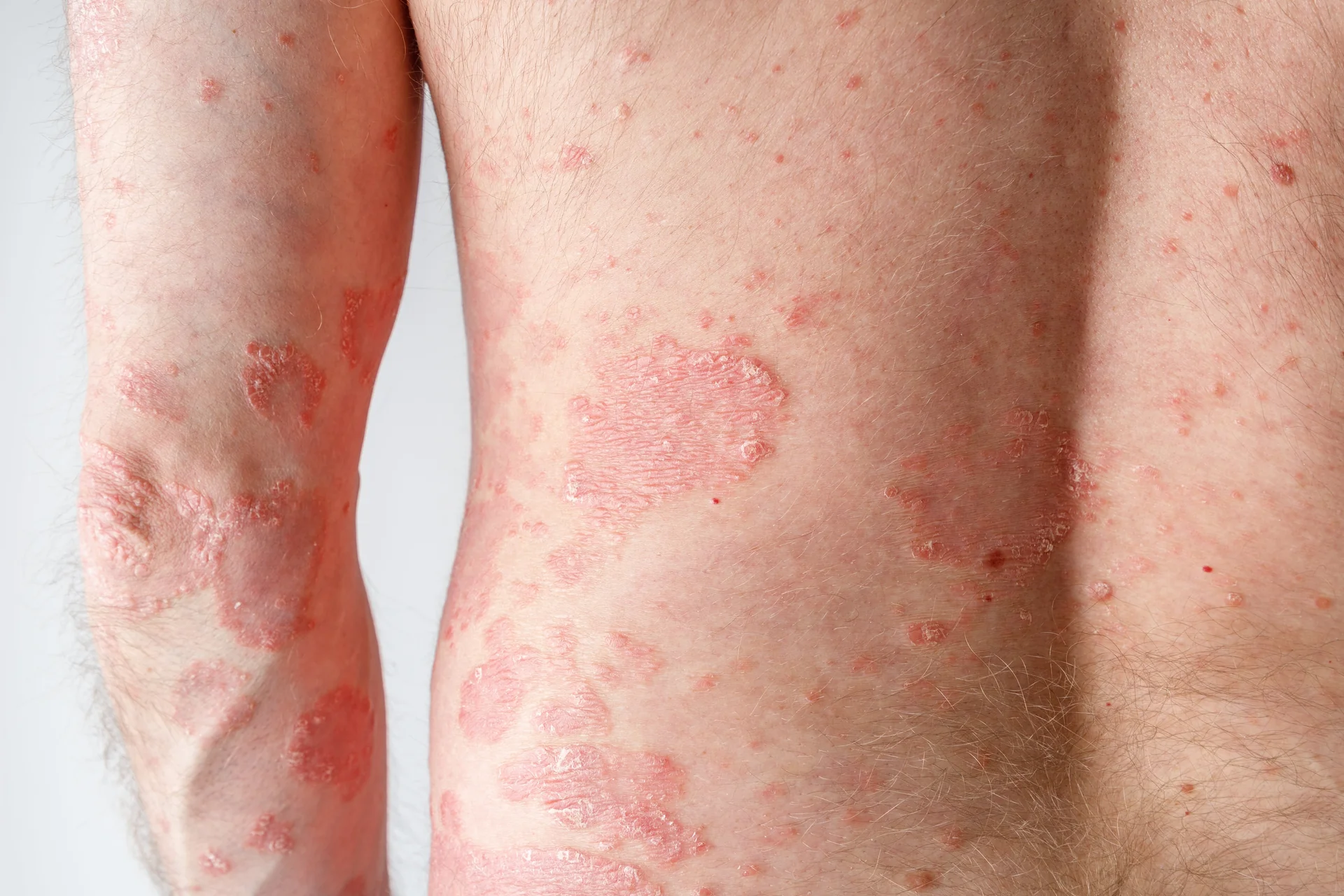
Pityriasis rosea is a skin condition that causes pink, red, brown, purple, or slightly scaly patches on the skin.
It most often appears on the trunk, but it can also affect the arms, thighs, neck, and other areas.
In many cases, it begins with a larger lesion called the herald patch.
After a few days or weeks, smaller patches may appear around it, creating a more widespread rash.
Although the number of lesions can be alarming, pityriasis rosea is usually benign and self-limited.
This means that, in most people, it improves on its own over time.
Treatment, when needed, usually focuses on relieving itching, irritation, and discomfort.
Important: pityriasis rosea is not the same as eczema, ringworm, psoriasis, or rosacea, although it can sometimes be confused with these conditions.
Why is it called pityriasis rosea?
The word “pityriasis” is used in dermatology to describe skin lesions with fine scaling.
The word “rosea” refers to the pink or reddish color that the patches may have, especially on lighter skin tones.
On darker skin, the lesions may look brown, purple, gray, lighter than the surrounding skin, or darker than the surrounding skin.
For this reason, the name does not perfectly describe every case.
Even when the patches are not clearly pink, the diagnosis may still be pityriasis rosea if the clinical pattern fits.
What causes pityriasis rosea?
The exact cause of pityriasis rosea is not completely understood.
The most accepted theory is that it may be related to the body’s response to infectious agents, especially certain viruses.
Several studies have investigated viruses from the herpesvirus family, particularly HHV-6 and HHV-7.
These viruses are different from the viruses that cause cold sores or genital herpes.
Pityriasis rosea is not considered a sexually transmitted infection, and it does not mean that a person has genital herpes.
In some people, the rash may appear after mild symptoms such as:
- General malaise.
- Sore throat.
- Fatigue.
- Body aches.
- Low-grade fever.
- Cold-like symptoms.
Not everyone has these symptoms before the skin changes.
In many cases, the person notices only the rash.
Important: pityriasis rosea is usually not caused by poor hygiene, lack of bathing, a specific food, or a simple food allergy.
Is pityriasis rosea contagious?
Pityriasis rosea is not considered a highly contagious skin disease.
It does not usually spread easily from one person to another through everyday contact.
There is usually no need to isolate the person, separate cutlery, avoid hugs, or keep children away from school only because of this diagnosis.
It is not usually transmitted by:
- Hugging.
- Shaking hands.
- Using the same bathroom.
- Casual sharing of spaces.
- Ordinary social contact.
Because the exact cause is not fully defined, questions about transmission are common.
In practice, however, pityriasis rosea does not behave like a typical contagious skin infection.
Symptoms of pityriasis rosea
The main symptom of pityriasis rosea is the appearance of patches on the skin.
These patches may have features such as:
- Oval or round shape.
- Pink, red, brown, purple, or grayish color.
- Fine scaling.
- Slightly raised or scaly borders.
- Distribution on the trunk and nearby areas.
- Variable itching.
Some people may also have general symptoms before or during the rash, such as:
- Fatigue.
- Headache.
- Sore throat.
- General malaise.
- Body aches.
- Low-grade fever.
The intensity varies widely.
Some people have only a few patches and almost no symptoms.
Others develop many lesions and significant itching.
What is the herald patch?
The herald patch is often the first lesion to appear in pityriasis rosea.
It is usually larger than the other patches.
It often has an oval shape, pink or reddish color, and fine scaling near the border.
It commonly appears on the trunk, abdomen, back, or chest.
Because it starts as a single patch, it can initially be mistaken for ringworm, nummular eczema, an allergic reaction, or a localized irritation.
After a few days or weeks, smaller secondary lesions may appear.
When this happens, the pattern of pityriasis rosea becomes more recognizable.
Important: not everyone notices the herald patch. In some cases, it is missed or does not appear in a typical way.
How do the other patches appear?
After the herald patch, several smaller patches may develop on the body.
These secondary lesions usually appear in crops over days or weeks.
They often have an oval shape and fine scaling.
In many cases, they follow the natural lines of the skin.
For this reason, on the back, they may form a pattern known as the Christmas tree pattern.
Secondary lesions may appear on the:
- Back.
- Chest.
- Abdomen.
- Neck.
- Arms.
- Thighs.
The palms, soles, and face are usually less affected in classic cases.
When these areas are significantly involved, other diagnoses may need to be considered.
What is the Christmas tree pattern?
The Christmas tree pattern is a description used when the lesions on the back follow the natural lines of the skin.
The patches may angle outward in a way that resembles branches.
This pattern is suggestive of pityriasis rosea, especially when a herald patch appeared first.
However, not every case shows this classic pattern.
Some people have less organized lesions, lesions in different areas, or atypical forms.
For this reason, diagnosis should not rely on this sign alone.
Where do the lesions usually appear?
Pityriasis rosea most often appears on the trunk.
Common areas include:
- Back.
- Chest.
- Abdomen.
- Flanks.
- Neck.
- Upper arms.
- Thighs.
The face, hands, and feet are usually spared in typical presentations.
In children, people with darker skin, or atypical cases, the distribution may be different.
When lesions appear on the palms, soles, mucous membranes, genital area, or with significant sores, medical evaluation is important to rule out other causes.
Does pityriasis rosea itch?
Yes, it can itch.
Itching varies greatly from person to person.
Some people have mild itching or no itching at all.
Others may have moderate or intense itching, especially with heat, sweating, friction from clothing, or very hot showers.
Itching may worsen with:
- Hot showers.
- Harsh soaps.
- Tight clothing.
- Sweating.
- Heat.
- Friction.
- Dry skin.
When itching is significant, treatment may include moisturizers, soothing measures, antihistamines, or topical medications recommended by a healthcare professional.
Intense scratching can cause excoriations, residual marks, and secondary infection.
How does it appear on darker skin?
On darker skin, pityriasis rosea may not look clearly pink.
The lesions may appear:
- Brown.
- Purple.
- Grayish.
- Lighter than the surrounding skin.
- Darker than the surrounding skin.
Fine scaling may be more noticeable than redness.
There may also be a higher chance of residual color changes after inflammation, known as post-inflammatory hyperpigmentation or hypopigmentation.
These residual marks may persist for weeks or months, even after the inflammation improves.
Important: the absence of a clearly pink color does not rule out pityriasis rosea.
Less common forms
The classic form of pityriasis rosea is the best known, but less common presentations can occur.
Some variants include:
Inverse pityriasis rosea
In this form, lesions appear more often in skin folds or on the extremities rather than mainly on the trunk.
It may affect the armpits, groin, arms, legs, or face.
Papular pityriasis rosea
Instead of larger flat patches, small raised bumps called papules predominate.
This form may be more common in children and in people with darker skin.
Vesicular pityriasis rosea
This is a rarer form with small blisters.
It may be confused with other skin diseases and usually requires careful evaluation.
Irritated pityriasis rosea
This occurs when the lesions become redder, more inflamed, or intensely itchy, often due to heat, sweating, friction, or irritating products.
Pityriasis rosea-like drug eruption
Some medications can cause rashes that resemble pityriasis rosea.
In these cases, recent medication history is important for diagnosis.
Important: atypical forms deserve medical evaluation because they may resemble other skin diseases.
Differences between pityriasis rosea, ringworm, eczema, psoriasis, and allergy
Pityriasis rosea can be confused with several skin conditions.
Ringworm
Ringworm often forms ring-shaped lesions with a more active border and progressive enlargement.
It may itch and scale.
Sometimes, the herald patch of pityriasis rosea looks like ringworm at first.
When there is doubt, a healthcare professional may request a fungal test or recommend specific treatment.
Nummular eczema
Nummular eczema forms round or coin-shaped lesions.
It often itches significantly and may be associated with dry skin, atopic dermatitis, or irritation.
The lesions may be more inflamed, moist, or crusted.
Guttate psoriasis
Guttate psoriasis causes small red and scaly lesions, often after a throat infection.
It may appear on the trunk, arms, and legs.
The scaling may be thicker and more silvery-white in some cases.
Skin allergy
Allergic reactions can cause red patches, plaques, itching, and swelling.
They are often related to a medication, food, skin product, contact exposure, or hives.
Hives usually form raised areas that move or change within hours.
Rosacea
Rosacea usually affects the face, causing redness, visible blood vessels, sensitivity, and sometimes acne-like bumps.
It is not the same condition as pityriasis rosea, despite the similarity in name.
Secondary syphilis
Secondary syphilis can cause a body rash and may involve the palms and soles.
Because it can mimic many dermatological conditions, it should be considered in certain clinical situations.
Important: the appearance of the skin helps, but it is not always enough. In uncertain cases, tests may be needed.
Diagnosis
The diagnosis of pityriasis rosea is usually clinical.
This means that a healthcare professional evaluates the appearance of the lesions, their distribution, the presence of a herald patch, the evolution of the rash, and associated symptoms.
During evaluation, the following may be considered:
- When the first patch appeared.
- Whether a larger patch appeared before the others.
- How the lesions spread.
- Whether itching is present.
- Whether fever, malaise, or respiratory symptoms occurred before the rash.
- Whether the person recently used any new medication.
- Whether there is risk of sexually transmitted infections.
- Whether the person is pregnant.
- Whether there is immunosuppression.
When the presentation is classic, tests may not be needed.
When the rash is atypical, persistent, or different from what is expected, further investigation may be appropriate.
When may tests be needed?
Tests may be requested when there is diagnostic uncertainty or signs that suggest another condition.
Depending on the case, tests may include:
- Fungal scraping or microscopy.
- Skin scraping.
- Syphilis testing.
- Blood tests in selected situations.
- Skin biopsy if the diagnosis remains unclear.
Biopsy is rarely necessary in typical cases, but it may help when there is uncertainty with psoriasis, dermatitis, ringworm, drug eruption, or other inflammatory skin diseases.
Important: using antifungals, strong corticosteroids, or home remedies without a diagnosis is not recommended, because this may mask other diseases and delay appropriate treatment.
Treatment of pityriasis rosea
In most cases, pityriasis rosea improves on its own.
The rash often lasts several weeks, although it may persist longer in some people.
Treatment is mainly symptomatic, meaning it focuses on relieving itching, irritation, and discomfort.
Moisturizing the skin
Gentle moisturizers can reduce dryness, scaling, and itching.
Fragrance-free products designed for sensitive skin are often better tolerated.
Avoiding irritants
Harsh products may worsen irritation.
It is generally recommended to avoid:
- Strongly scented soaps.
- Scrubs.
- Acids without guidance.
- Home remedies.
- Very hot showers.
- Rough sponges or washcloths.
Medicines for itching
When itching is significant, a healthcare professional may recommend antihistamines.
In some cases, low- or medium-potency topical corticosteroids may be used for a short period to relieve inflammation and itching.
The choice depends on age, lesion location, itch intensity, and skin characteristics.
Phototherapy
In extensive, very symptomatic, or persistent cases, phototherapy may be considered by a dermatologist.
This treatment uses ultraviolet light in a controlled medical setting.
It is not the same as unprotected sun exposure.
Antiviral medication
In selected cases, especially when the rash is severe or diagnosed early, some clinicians may consider antiviral medication.
However, this is not necessary for most patients.
The decision should be individualized.
Important: because most cases improve spontaneously, the main goal is to control symptoms and avoid skin irritation.
Daily care
Some measures can help reduce itching and irritation during the rash.
- Take lukewarm showers instead of hot showers.
- Use gentle soaps.
- Avoid scrubbing the skin.
- Apply moisturizer after bathing.
- Wear light and comfortable clothing.
- Avoid excessive heat.
- Avoid heavy sweating if it worsens itching.
- Do not scratch aggressively.
- Avoid new skin products until the rash improves.
- Do not use strong ointments without guidance.
If residual marks remain after the rash improves, sunscreen may help reduce contrast and darkening, especially on exposed areas.
Pityriasis rosea during pregnancy
Pityriasis rosea during pregnancy deserves medical evaluation.
Although many cases are mild, some studies suggest that pityriasis rosea early in pregnancy may be associated with a higher risk of complications in certain situations.
This risk appears to depend on factors such as gestational age, severity of the rash, systemic symptoms, and individual characteristics.
Pregnant people with suspected pityriasis rosea should seek guidance to confirm the diagnosis and rule out other causes of skin rash.
Evaluation is especially important when there is:
- Very extensive rash.
- Fever.
- Significant malaise.
- Atypical lesions.
- Intense itching.
- Onset during the first trimester.
- Uncertainty with other infections.
Important: pregnant people should not use medications, creams, or treatments without professional guidance.
Possible complications
Pityriasis rosea usually has a good outcome.
Even so, some issues may occur:
- Intense itching.
- Irritation from friction or sweating.
- Scratches from itching.
- Secondary skin infection.
- Residual light or dark marks.
- Temporary cosmetic concern.
- Anxiety due to the number of patches.
- Persistent or recurrent rash in less common cases.
Residual marks are more common when inflammation is intense, scratching occurs, sun exposure is significant, or the skin is more prone to hyperpigmentation.
These changes usually improve gradually, but they may take time.
When to seek medical care
Seek medical evaluation if you develop a new, widespread, or persistent rash.
Evaluation is especially important if there is:
- Lesions on the palms or soles.
- Sores in the mouth or genital area.
- High fever.
- Severe malaise.
- Significant pain.
- Pus or signs of infection.
- Very painful lesions.
- Blisters.
- Extensive peeling of the skin.
- Purple spots that do not fade when pressed.
- Recent use of a new medication.
- Pregnancy.
- Immunosuppression.
- Persistence longer than expected.
- Uncertainty with ringworm, allergy, psoriasis, or a sexually transmitted infection.
Important: some more serious conditions can resemble pityriasis rosea at first. Atypical cases should be evaluated.
Myths and facts
“Pityriasis rosea can begin with one larger patch.”
Fact.
“Pityriasis rosea is always ringworm.”
Myth.
“The condition often improves on its own.”
Fact.
“Everyone with pityriasis rosea needs antibiotics.”
Myth.
“Itching can range from mild to intense.”
Fact.
“Pityriasis rosea is caused by poor hygiene.”
Myth.
“The patches may follow a Christmas tree-like pattern on the back.”
Fact.
“Pityriasis rosea and rosacea are the same disease.”
Myth.
“On darker skin, the patches may look brown or purple.”
Fact.
“Pregnant people with suspected pityriasis rosea should seek medical guidance.”
Fact.
Quick FAQ
What is pityriasis rosea?
It is a skin condition that causes pink, red, brown, purple, or scaly patches, usually on the trunk, and is self-limited in most cases.
Is pityriasis rosea ringworm?
No. It can look like ringworm, especially at the beginning, but it is a different condition.
Is pityriasis rosea eczema?
No. It may be confused with eczema, but it is not the same disease.
Is pityriasis rosea contagious?
It is not considered highly contagious and does not usually spread through ordinary social contact.
How long does it last?
Many cases improve within several weeks, but duration can vary. Some people may have residual marks for longer.
Does it itch a lot?
It can. Some people have mild itching, while others may have intense itching.
Does it need treatment?
Not always. Treatment usually focuses on relieving itching and irritation.
Can sun exposure help?
Unprotected sun exposure may irritate the skin and cause marks. Phototherapy, when indicated, is performed in a controlled medical setting.
Can I use antifungal cream?
Treatment without a diagnosis is not recommended. If it is pityriasis rosea, antifungal treatment may not help. If it is ringworm, the correct treatment is needed.
Can pityriasis rosea come back?
Recurrence is possible, but it is not the most common outcome.
Can it leave marks?
It can leave temporary light or dark marks, especially on darker skin or when there is significant itching and inflammation.
When should I see a doctor?
Seek evaluation if there is diagnostic uncertainty, atypical lesions, pregnancy, immunosuppression, fever, pain, blisters, pus, lesions on the palms or soles, or prolonged persistence.
Important disclaimer
This content is for educational purposes only and does not replace professional medical evaluation. Skin patches and rashes can have many causes, including ringworm, eczema, psoriasis, allergies, drug reactions, and infections. Seek medical care if there is fever, severe pain, pus, blisters, sores on mucous membranes, lesions on the palms or soles, recent medication use, pregnancy, immunosuppression, or progressive worsening. Do not use strong corticosteroid creams, antifungals, acids, antibiotics, or home remedies without professional guidance.
References and further reading
- American Academy of Dermatology (AAD). Pityriasis rosea: overview, symptoms, and treatment.
- DermNet NZ. Pityriasis rosea.
- British Association of Dermatologists. Pityriasis rosea patient information.
- Merck Manual Professional Version. Pityriasis rosea.
- Mayo Clinic. Pityriasis rosea: symptoms and causes.
- Cleveland Clinic. Pityriasis rosea: diagnosis and treatment.
- StatPearls. Pityriasis Rosea.
- UpToDate. Pityriasis rosea: clinical manifestations and diagnosis.
- Journal of the American Academy of Dermatology. Reviews on pityriasis rosea and pityriasis rosea-like eruptions.
- Pediatric Dermatology. Pityriasis rosea in children and atypical presentations.